

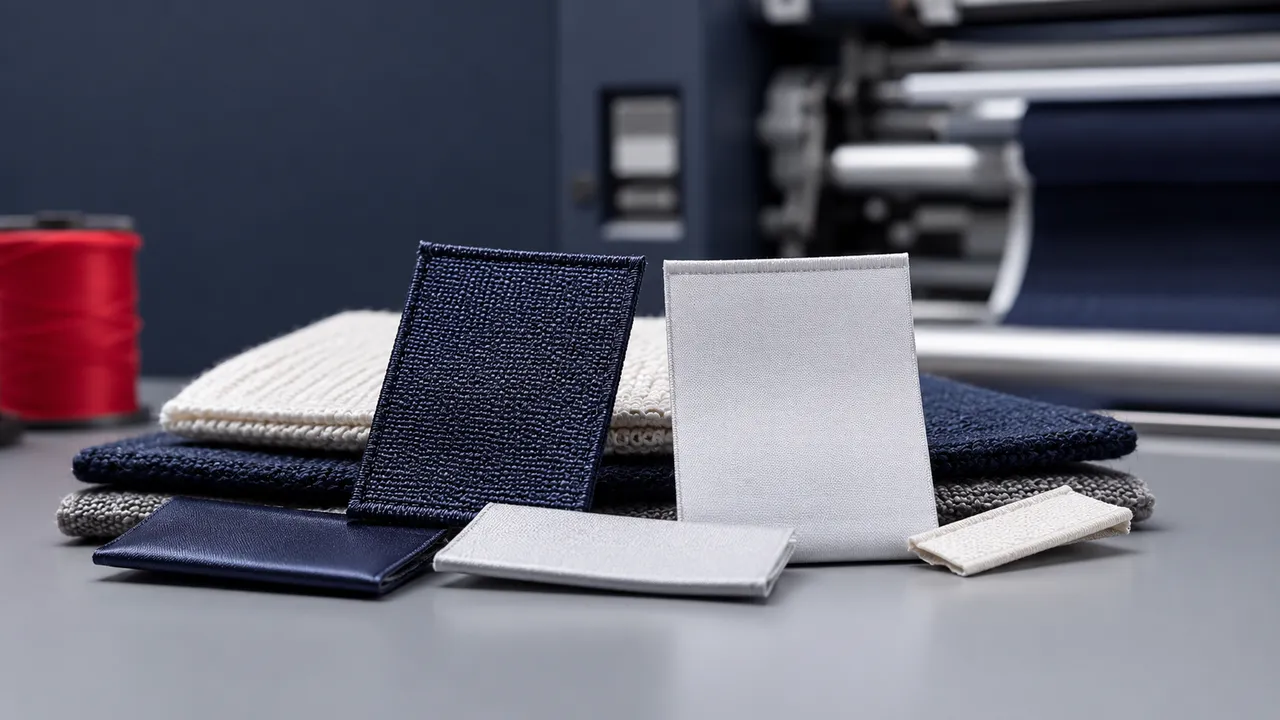
Choosing between woven and printed fabric labels is one of the first decisions apparel and textile brands face. Both carry your brand on a garment, but they are made differently and suit different needs. This guide compares them on construction, durability, detail, cost and typical use cases.
- Woven: colour is part of the weave → no fading, premium textured feel; ideal for brand/neck labels.
- Printed fabric: easily carries fine detail, small text, multilingual info and QR codes; ideal for care/size/composition labels.
- Many brands use both: a woven brand label with a printed care label.
- For skin contact, what matters is material safety (OEKO-TEX), not the construction type.
What are woven labels?
Woven labels are created on jacquard looms: the design is woven directly from yarns (typically polyester, in satin or damask weaves) rather than printed. Because the colours are part of the weave, they do not fade or wash off, giving excellent durability and a textured, premium feel.
They are the natural choice for neck and brand labels where a high-quality tactile finish reinforces brand perception. The trade-off: very fine detail, very small text and photographic gradients are limited by thread density.
What are printed fabric labels?
Printed fabric labels are produced by printing ink onto a fabric base (satin, taffeta or cotton). Printing reproduces fine detail, small text, multiple languages and elements such as QR codes far more easily than weaving.
This makes them ideal for care, size and composition labels that must carry wash symbols and multilingual instructions. Softness and lower cost for complex artwork are advantages; long-term wash durability depends on the ink and finishing used.
Quick comparison
| Criterion | Woven labels | Printed fabric labels |
|---|---|---|
| Construction | Woven from yarns (jacquard) | Ink printed on fabric |
| Feel | Textured, premium | Smooth, soft |
| Durability | Very high (colour in the weave) | Good (depends on ink/finish) |
| Fine detail / small text | Limited | Excellent |
| Multilingual care info | Harder | Easy |
| QR codes | Not ideal | Easy to print |
| Typical use | Brand / neck labels | Care / size / composition labels |
| Relative cost for complex art | Higher | Lower |
Durability & skin comfort
Woven labels are generally the more durable, textured option, while modern soft-woven and well-finished printed labels can both sit comfortably against the skin. For garments in direct skin contact, the most important factor is the material safety — choose certified materials such as OEKO-TEX rather than relying on construction type alone.
Which should you choose?
- Choose woven for brand / neck labels and premium positioning.
- Choose printed for care, size, composition and multilingual information, QR codes, or detailed and complex artwork.
- Use both — many brands pair a woven brand label with a printed care label in the same garment.
Still unsure which fits your product? The fastest way to decide is to compare physical samples of both on your own fabric.
Frequently Asked Questions
Are woven labels more durable than printed ones?
Generally yes; because the colour is part of the weave it does not fade or wash off. Printed durability depends on the ink and finishing used.
Can I put a QR code on the label?
Yes, easily on a printed fabric label; woven labels are not suitable for QR codes.
Can I use both on the same garment?
Yes; pairing a woven brand label with a printed care label is a common approach.